


Looking for information on the internet today is no longer like it was five years ago. We chat with Siri in the car, we get an instant response on Google without even clicking… And sometimes, we let ourselves be surprised by an ultra-complete summary of ChatGPT.
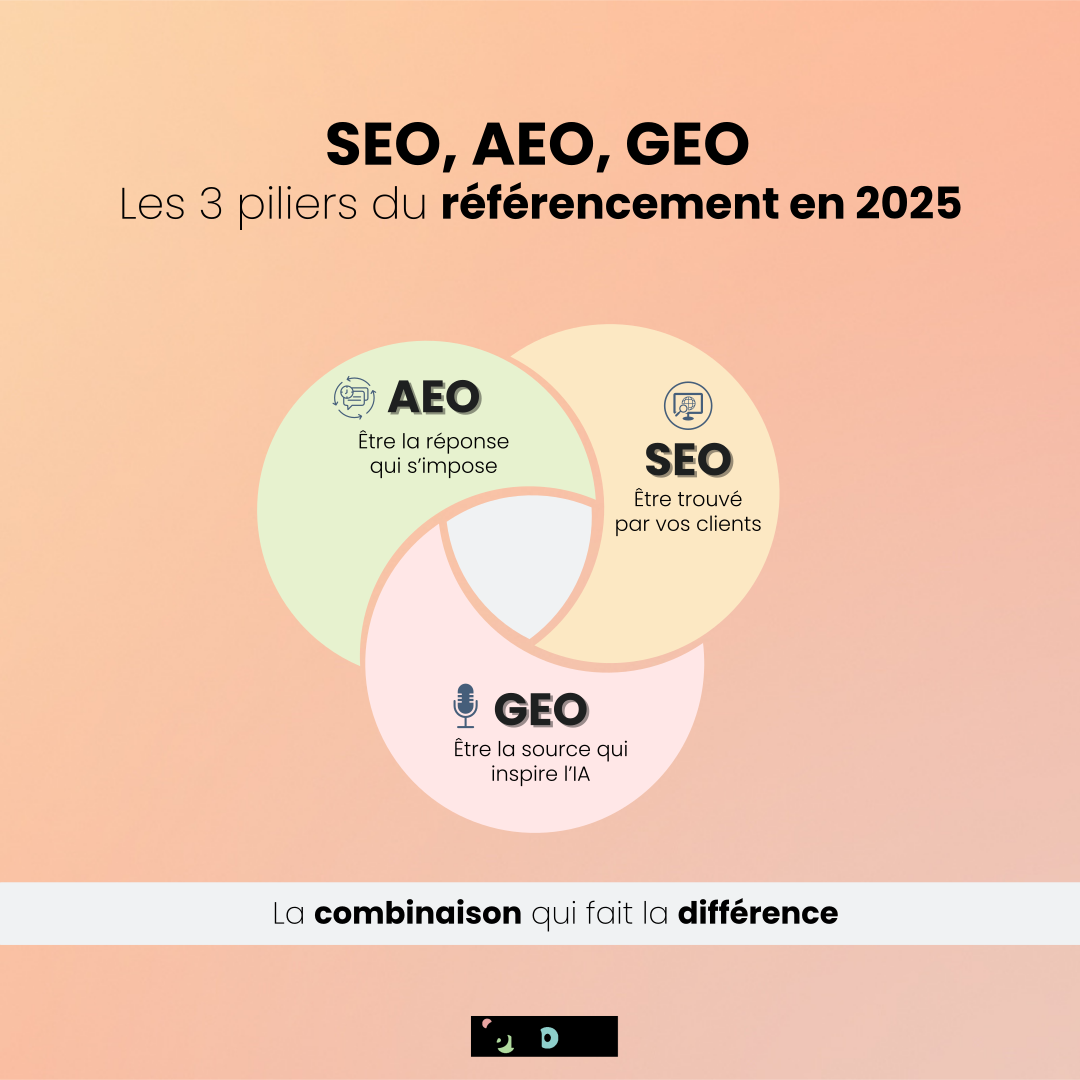
SEO has changed. We're no longer just talking about SEO: now, AEO and GEO are shaking things up. Behind these acronyms, there is above all one thing: the need to be visible where your customers are really looking.
SEO, AEO, GEO: Express summary to understand in 30 seconds
How is SEO reinventing itself in the age of AI in 2025?
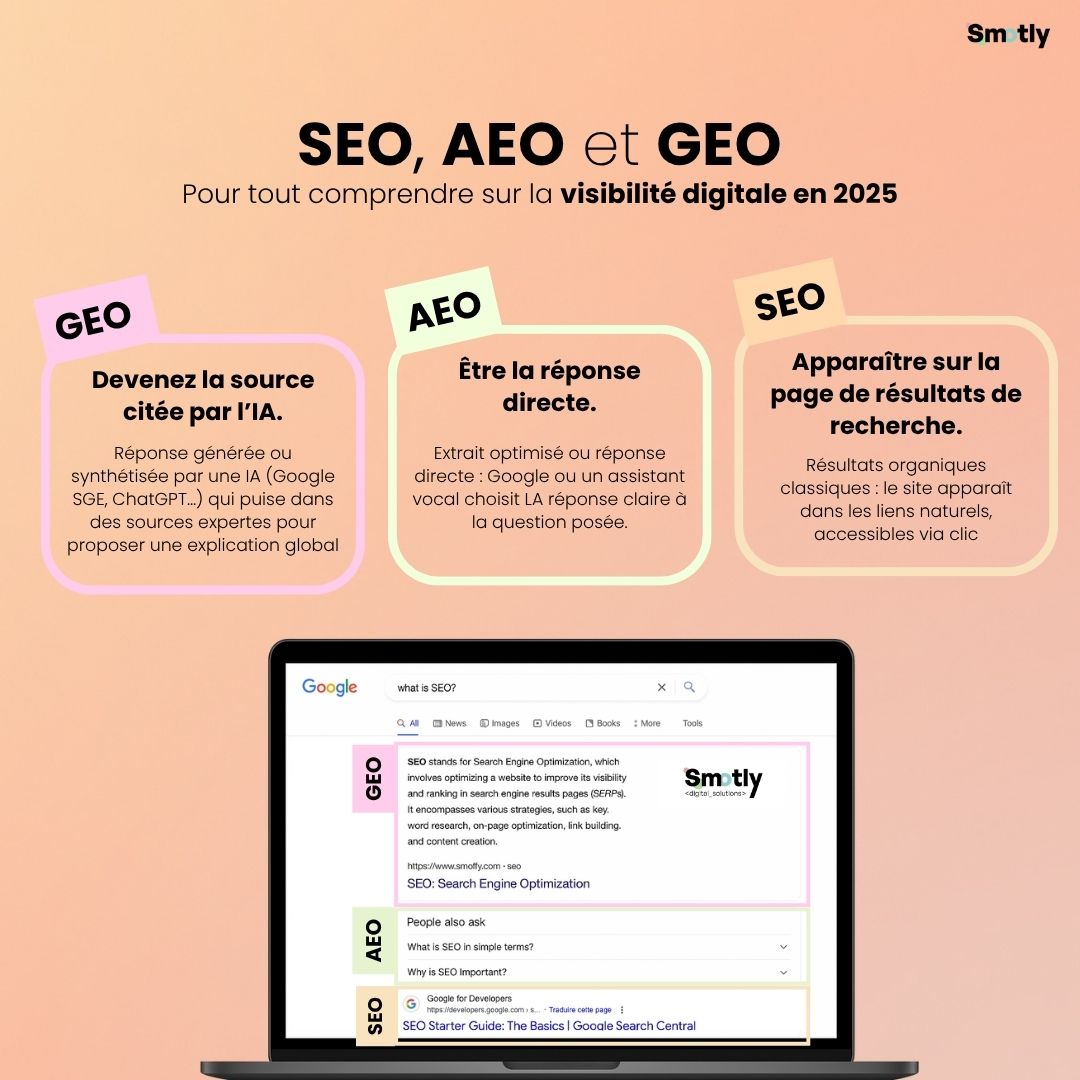
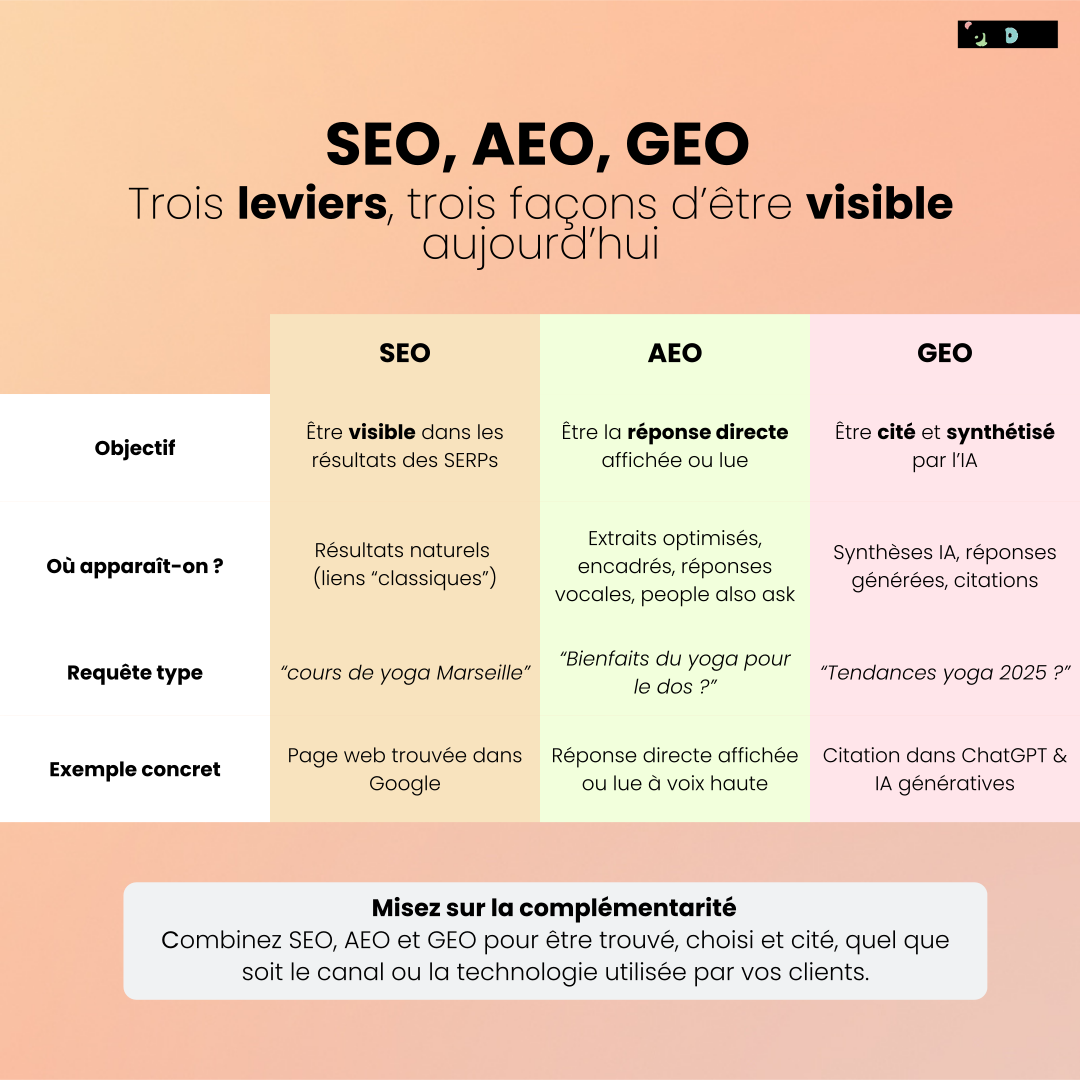
SEO - Search Engine Optimization: Attract attention and bring the prospect to your home. Example: You want someone looking for “yoga classes in Marseille” to come across your site, consult your articles, discover your offers.
AEO – Answer Engine Optimization: Be THE voice that answers the question. Example: When someone asks “What are the benefits of yoga for the back?”, Google or Siri reads your answer, not the competitor’s.
GEO - Generative Engine Optimization: Be cited as a reference, even when you have not been looked for. Example: In an AI summary on “Well-being trends 2025”, your study or testimony is highlighted: you become the trusted source.
These three strategies do not oppose each other: they complement each other. A site that combines all three shines everywhere: on Google, in voice responses, in AI summaries… and in the minds of its future customers.
What is SEO and why it remains essential for visibility on the internet?

SEO is the cornerstone of any digital strategy. A site without visibility is a bit like a quality store hidden in an alley: no matter how excellent your products or services are, no one will discover them without walking past your window.
En 2025, le SEO demeure à la fois une discipline technique et un levier stratégique. Si les bases restent incontournables: choix des mots-clés, optimisation des balises, netlinking: la véritable différence se joue désormais sur trois axes majeurs :
1️⃣ Really useful and user-oriented content. For example, a carpenter in Lille who publishes a practical guide on “How to choose a custom-made staircase?” » does not just please Google: it attracts a qualified audience, actively looking for concrete solutions.
2️⃣ An impeccable web experience, especially on mobile. Today, a slow site or one poorly adapted to smartphones is equivalent to losing half of your potential visitors. Google, like your future customers, prioritizes speed, clarity and ergonomics.
3️⃣ A solid and authentic digital reputation. Quality backlinks, customer reviews, mentions on influential media or blogs are all signals of trust that carry weight in search engine algorithms.
You must keep in mind that SEO is a sustainable investment. Well-optimized and positioned content today can continue to generate leads or sales for months or even years. This is the quiet strength of SEO: invisibility today, notoriety and business tomorrow.
How does AEO transform your direct response content?
Answer Engine Optimization (AEO) is changing the rules of the web content game. In 2025, users expect immediate and precise responses, whether via Google, a voice assistant or artificial intelligence. The AEO aims precisely to make your site the preferred source for these instant answers, without even requiring an additional click.
Why is the AEO a real strategic lever?
The evolution of uses is obvious:
- The zero click” phenomenon is accelerating: according to the latest studies, more than half of searches on Google now result in an answer displayed directly on the results page. The user obtains the information sought without visiting a site, and the brand that provides the answer gains immediate notoriety.
- Voice search is essential (connected speakers, smartphones, cars, etc.): the questions are formulated orally, in a natural and contextual way (“What are the town hall hours today?”, “How to remove a red wine stain?”…). The engines then favor structured and concise content.
🌟 The keys to a successful AEO strategy
Identify and anticipate your customers' real questions It's about putting yourself in the user's shoes: what are their concrete questions, in what situations are they looking for a quick answer? Example: a Toulouse restaurateur can create an FAQ section covering “Do you offer a vegetarian menu?” », “Can we come with an animal? », “What are your opening hours on Sunday? ". It targets high-intent queries to occupy “zero positions”.
Structure your answers clearly and effectively Content that performs well in AEO is short (often less than 50 words), precise and organized (titles, bulleted lists, short paragraphs). Readability makes it easier for search engines to automatically extract it and increases your chances of being selected as a direct answer.
Implement FAQ or HowTo markup (Schema.org structured data) These tags help Google and other engines understand the structure of your content, thus optimizing your chances of appearing in answer boxes, featured snippets or voice search results.
What the AEO actually changes for your visibility
Today, more and more decisions or research are made using AI. We no longer systematically type a query into Google: we ask an assistant what they think, or we read a generated summary.
The real question therefore becomes: is your content interesting, credible and original enough to be used?
When a prospect reads: “According to the 2025 study by the Smotly agency, 62% of French SMEs have experienced at least one cybersecurity incident this year…” You no longer only reach those who visit your site: you mark everyone who obtains information via AI.
GEO: How to become the source that AI retains (and cites)?
GEO – Generative Engine Optimization – is the new SEO playing field: it is no longer just a question of pleasing Google but of succeeding in becoming THE resource from which artificial intelligences draw when they write their answers for Internet users.
In short: you want, when a customer asks a question to ChatGPT, Gemini or Perplexity, it is your brand, your analysis, your experience that emerges in the summary. And that changes everything for your reputation!
Why is GEO becoming a decisive issue?
Today, more and more decisions or research are made using AI. We no longer systematically type a query into Google: we ask an assistant what they think, or we read a generated summary.
The real question therefore becomes: is your content interesting, credible and original enough to be used?
When a prospect reads: “According to the 2025 study by the Smotly agency, 62% of French SMEs have experienced at least one cybersecurity incident this year…” You no longer only reach those who visit your site: you mark everyone who obtains information via AI.
🌟 How to perform for GEO?
Share what you experience, not what everyone repeats. Publish feedback, a customer anecdote, an in-house analysis. It is this “real” content that attracts the eye (and the algorithm) of AI.
Take care of your form: stories, figures, examples. Are you a sports coach? Tells how a client doubled their energy in 3 months, with supporting figures. Are you an HR consultant? Analyze the most common mistakes you observe among recruiters.
Make your content digestible. Meaningful titles, short paragraphs, cited sources: the clearer it is, the more “AI-friendly” it is. But keep your personality, your tone, your style.
Assert your expertise without overdoing it. Talk about your successes, your failures, what you learn in the field. This is what makes you credible and sets you apart.
A concrete example: Paul, cybersecurity expert, publishes each year a barometer on the vulnerabilities encountered by his SME clients. It goes beyond the numbers: it tells how a company narrowly avoided a scam thanks to a simple trick. Result: when an AI has to illustrate a subject on cybersecurity, it cites not only its figures, but also its stories, because they are concrete, embodied and useful.
The more you share what you know and what you experience, the more likely you are to be cited, recognized... and chosen, even in the age of AI.
How to apply these strategies according to your sector of activity?
| Secteur | Objectif SEO | AEO objective (direct response) | GEO objective (AI reference) |
|---|---|---|---|
| Professionnel local | Be found on Google and Maps (file, local articles) | Answer practical questions: opening hours, contacts, services | Be cited in local AI summaries, neighborhood trends |
| E-commerce | Generate traffic on product sheets, buying guides | Resolve doubts: size, delivery, maintenance, returns | Become the trusted brand included in AI comparisons |
| B2B / Business | Capture business research, publish case studies | Clarify concepts, offer specialized guides or FAQs | Publish analyses/benchmarks that power AI responses |
Action plan: boost your SEO, AEO and GEO visibility — step by step

SEO, AEO, GEO audit: Where are you?
- SEO: Analyze your positions on Google on your main keywords. Are your key pages well referenced? How do you stack up against your competitors?
- AEO: Type your key questions into Google or test voice search: do you appear in featured snippets or direct answers?
- GEO: Ask ChatGPT, Gemini or Perplexity about your domain: is your company or your content cited by AI? Which experts are highlighted?

SEO ACTIONS: improve the existing
- Identify your strategic pages and optimize them: titles, tags, high value-added content.
- Work on your backlinks and your e-reputation (reviews, mentions, shares on reference sites).
- Make sure your site is fast, secure and mobile-friendly.

AEO ACTIONS: think “direct response”
- Identify the 10 most asked questions by your customers or prospects.
- Write answers ultra-clear (less than 50 words), including bulleted lists or tables if relevant.
- Set up a structured FAQ with schema.org markup for easy Google extraction and voice search.

GEO ACTIONS: become the benchmark for AI
- Choose a topic where you have a unique point of view, data or feedback.
- Write an article or original study, citing your sources, your figures, your customers or partners.
- Distribute this content on your professional networks and monitor its replay (test AI prompts to see if you are cited).

Suivi & Optimisation continue (SEO / AEO / GEO)
- SEO: Measure the evolution of your positions and organic traffic. Google Search Console: To track your keywords, your positions in the SERP, clicks and impressions.Google Analytics (or Matomo): To analyze the evolution of your organic traffic, the bounce rate, the best performing landing pages.Positioning tracking tools (SEMrush, Ahrefs, Monitorank, Myposeo, etc.): To monitor the evolution of your positions on your target keywords and those of your competitors.
- AEO: Track the number of featured snippets obtained and test voice search regularly. SERP Checker or SEMrush/Ahrefs (“Featured Snippets” function): To see if your pages are getting featured snippets/position 0.Answer the Public, AlsoAsked: To find new questions to target and enrich your FAQ.Voice search testing tools (for example, testing on Google Assistant, Siri, Alexa…).
- GEO: Regularly ask an AI to summarize your sector or quote experts: check if you appear more and more often. ChatGPT, Perplexity, Bing Copilot, Gemini: Ask questions about your sector or your company and observe if your content is cited.Google Alerts, Mention, Talkwalker: To be notified as soon as your brand, your studies or your name are used online.BuzzSumo: To analyze the virality and resumption of your content on the web and networks.
Conclusion: The future of SEO is happening now
It’s no longer just a matter of reaching the top position on Google. Today, the challenge is to be present where your customers ask their questions: on search engines, with artificial intelligence, or via voice assistants.
For companies and professionals who will be able to focus on quality, clarity, authenticity and expertise, this is an exceptional opportunity to differentiate themselves and strengthen their influence.
SEO ensures your visibility, AEO makes you the reference answer, and GEO positions you as an essential source in the digital ecosystem of tomorrow.
Now is the time to act so that, tomorrow, your name, your brand and your expertise become references, both for human users and for artificial intelligence engines.