


StrapiConf 2025 marked a decisive turning point for the headless ecosystem. By announcing new native integrations, including Shopifys, Strapi confirms its desire to become an agile, powerful and interoperable universal content hub. For merchants and developers, the integration between Strapi and Shopify opens up ambitious prospects: more control, more personalization, and above all a frictionless omnichannel experience.
At Smotly, we are following this evolution very closely. Here is why Shopify + Strapi is the winning combination for e-commerce in 2025.
StrapiConf 2025, held in Paris on May 13, was not just another tech event: it signaled a shift in the world of headless CMS and modern e-commerce. For developers and marketers juggling editorial content and product catalogs every day, the announcements promise to drastically simplify workflows.
Watch the conference replay to see all the announcements about Strapi's future and the 2025 roadmap.
Native e-commerce integrations that change the game
The era of fragile workarounds and unstable third-party connectors is over. Strapi is finally formalizing integrations with e-commerce giants:
- Shopify and BigCommerce join Strapi's **native integrations,** alongside Cloudinary and AWS
- A custom Shopify field now makes it easy to link product records to any editorial content
- Webhooks automatically synchronize updates from your online store to your CMS
- An integrated product picker for BigCommerce and Shopify makes it easy to select products directly from the admin interface
In practice, your marketing team can now create landing pages, blog articles or campaigns that seamlessly embed products, without going through development.
A developer experience redesigned for greater efficiency
Strapi does not stop at e-commerce integrations. It also completely rethinks the development experience:
- Revolutionary Live Preview Real-time visualization of changes directly in the admin panel, side-by-side editing for a smooth workflow, and stronger collaboration between developers and content managers
- New typed client SDK Simplified front-end integration with a robust API client library, stronger type safety to reduce development errors, and better productivity through intelligent autocompletion
- Optimized Strapi Cloud Even faster deployment, including for complex architectures, an expanded free plan to test new features, and improved multi-environment support
The concrete impact for Shopify users
These evolutions mark a turning point for every e-commerce platform looking to enrich its content experience:
Less technical friction: no more custom development needed to synchronize products and content
Faster time to market: marketing campaigns can be created faster thanks to native integrations
Maximum flexibility: a headless architecture that preserves commercial performance while offering full creative freedom
Optimized collaboration: marketing and development teams finally work from the same page
The message is clear: the alliance between headless CMS and e-commerce platforms is no longer a workaround. It is a modern architecture designed for companies that want both commercial performance and rich editorial experiences.
Shopify + Strapi: the duo transforming e-commerce
A simple explanation of headless architecture
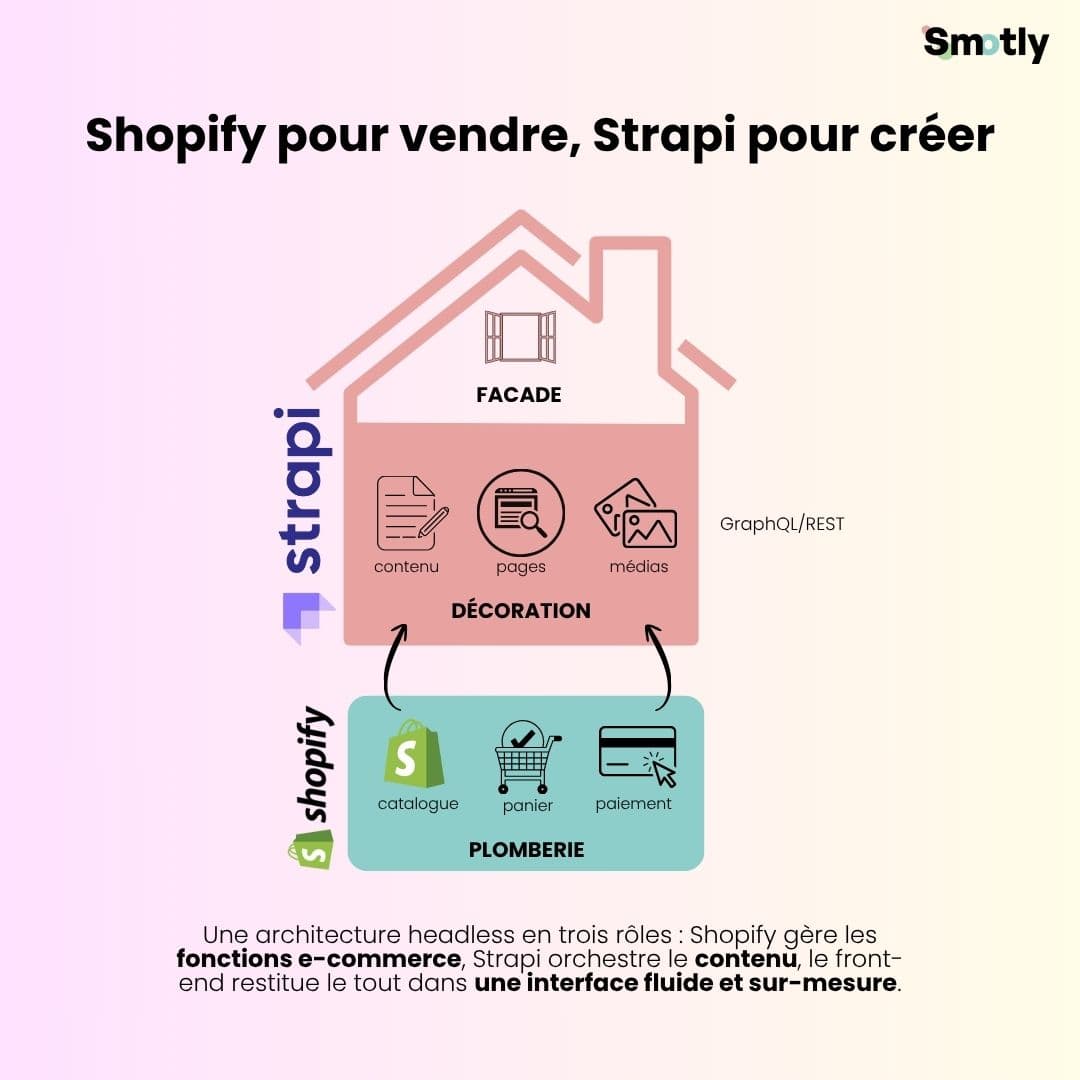
Imagine your e-commerce site as a house: Shopify would be the plumbing and electricity (catalog, cart, payment), Strapi would be the decoration and layout (content, pages, media), and your front end would be the facade visitors see. This separation lets each system do what it does best, without compromise.
The front-end consumes data via powerful APIs (GraphQL or REST), guaranteeing ultra-fast rendering on all media. This is what we call headless architecture: the head (interface) separated from the body (business logic). We'll detail it all here.
The limits of Shopify on its own
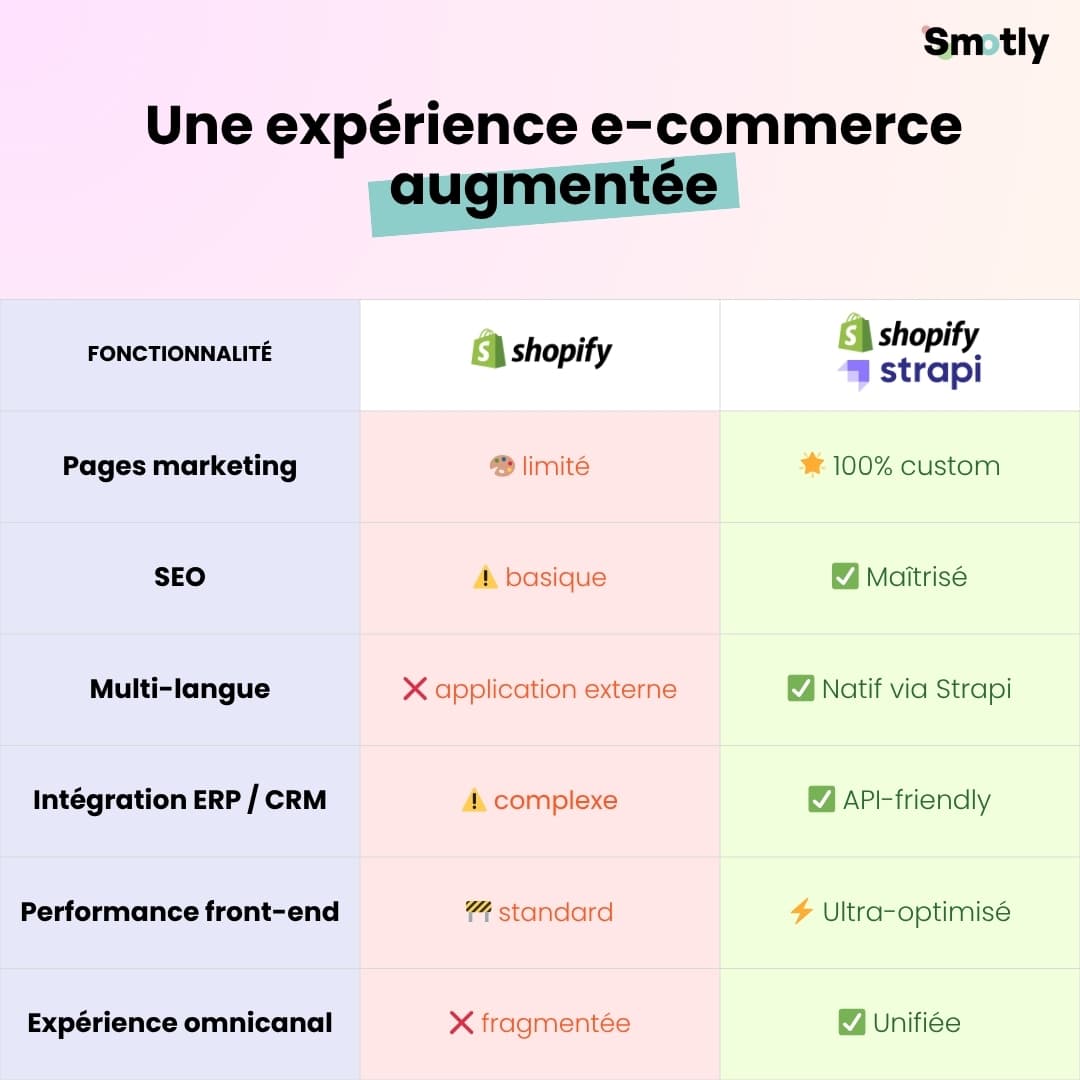
Shopify excels in its domain, but starts showing limits as soon as you move beyond pure transactions. Try creating an integrated lifestyle magazine, managing complex multilingual content, or connecting your ERP: you quickly end up patching things together with unreliable third-party apps.
Shopify is like a Ferrari: perfect on the track, not ideal for crossing the countryside with all your camping gear.
Strapi's decisive contribution
The official @strapi-community/shopify plugin completely changes the game. No more risky custom development: synchronization between your Shopify products and your Strapi content becomes native and automatic.
Key features:
- Multi-shop management from a single Strapi back office
- Product webhooks for real-time updates
- Custom cache, in memory or Redis, for optimal performance
- Automatic product data injection into your content
5 concrete benefits of the Shopify x Strapi alliance
Total creative flexibility
Performance: 3x faster
No more rigid templates! Every pixel of the customer experience becomes customizable. You can create a gamified purchasing funnel, an immersive product page with 360° video, or even an interactive configurator, without technical constraints.
Decoupled architectures enable optimizations that are impossible with a monolith. Smotly clients regularly see speed gains of 200 to 300% thanks to optimized front ends (Next.js, Nuxt) that load only what is strictly necessary.
SEO: finally in control of your visibility
Scalability without rebuilding
With Strapi, you control every tag, URL and meta description. No more frustration with Shopify's SEO limitations: you fine-tune every page according to your business needs.
New country? New language? New customer segment? The stack adapts organically to your growth, without requiring a major redesign.
Native omnichannel

One of the major strengths of the Shopify + Strapi alliance is its ability to deliver a true omnichannel experience that is coherent and smooth across every touchpoint.
With Shopify alone, you are well equipped to manage a classic e-commerce site, but you quickly become limited when you try to extend the experience: the mobile app remains hard to customize, newsletters are basic, in-store kiosks are not natively integrated, and social networks cannot be fully connected to the CMS.
By contrast, when you combine Shopify with Strapi, every channel becomes a natural extension of your ecosystem. The website keeps its performance, the mobile app can be dynamically powered through headless APIs, content shown on in-store kiosks or connected screens is managed from a single back office, email campaigns are enriched with contextualized content, and social networks can pull directly from the CMS to automate high-value content distribution.
When should you choose Shopify + Strapi?
This combination is especially relevant in several cases:
- You sell high-value products (technical, emotional, lifestyle) and need to tell a story and editorialize the experience.
- You are an international brand that wants to localize content by country, language or audience.
- You want advanced personalization of the customer experience, with dynamic blocks, custom funnels or contextual recommendations.
- You have a complex system to connect: ERP, PIM, DAM, CRM... Strapi shines through its integration capabilities.
In short: as soon as content becomes as important as the product, Shopify + Strapi becomes obvious.
Conclusion: the future belongs to decoupled architectures
The headless revolution is no longer a trend, it is reality. Brands that move now gain a decisive lead over their competitors.
The real question is no longer 'Should we go headless?' but 'How do we do it intelligently and quickly?'
With Shopify for e-commerce robustness, Strapi for content flexibility and Smotly to orchestrate it all, you get a modern, scalable and high-performing solution.
Ready to transform your e-commerce? Let's talk about your project: our experts support you from audit to launch.