

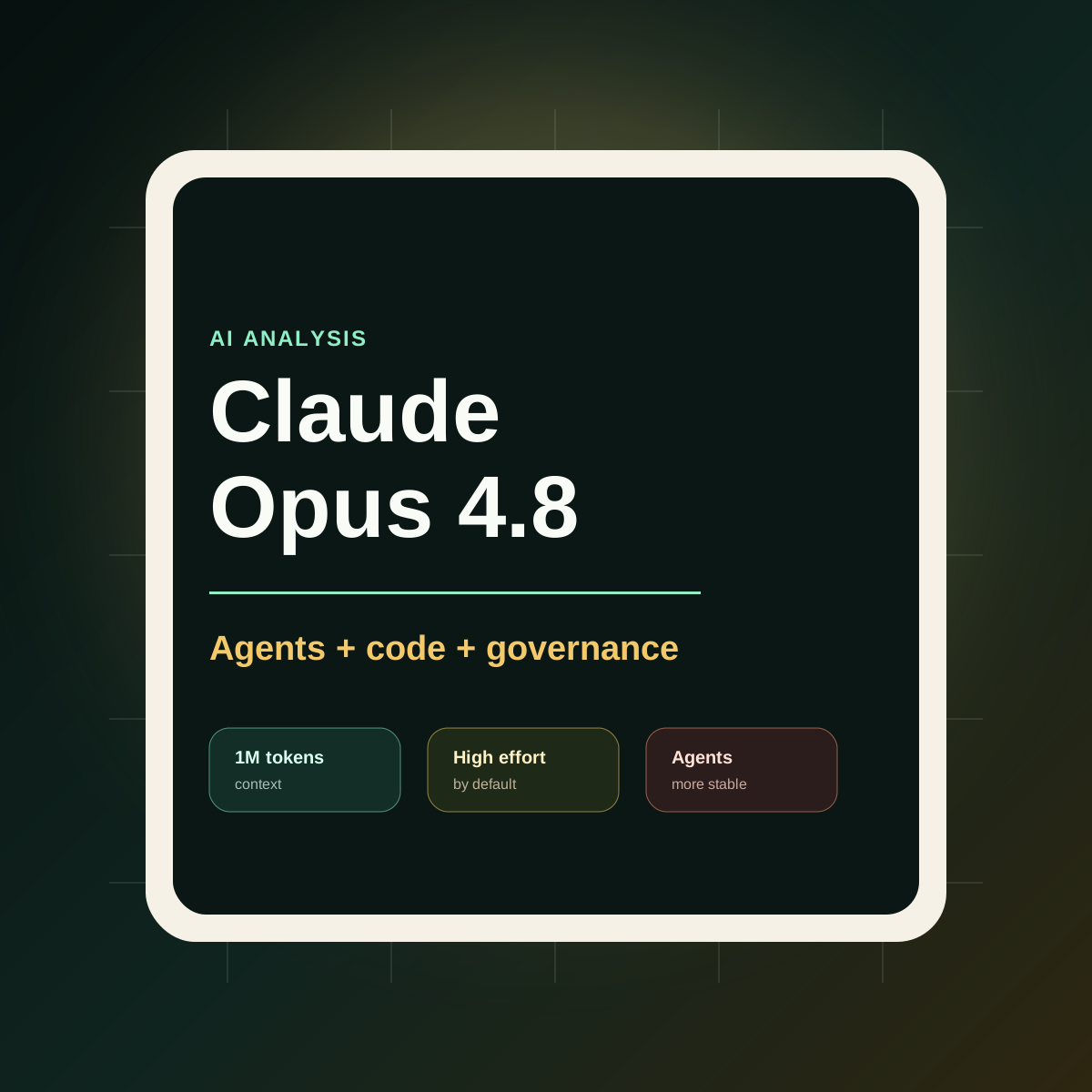
Anthropic announced Claude Opus 4.8 on May 28, 2026. The model is available immediately under the API identifier `claude-opus-4-8`, with the same standard price as Opus 4.7: $5 per million input tokens and $25 per million output tokens.
The exciting new thing isn't just a higher score. It comes from a change in behavior: Opus 4.8 is presented as more reliable for agentic tasks, more consistent over long sessions, more precise in its use of tools and more inclined to report uncertainties. For a team automating code, document analysis or business workflows, this is exactly where the value comes in.
What changes with Claude Opus 4.8
According to the official Anthropic announcement, Opus 4.8 improves performance in coding, reasoning, agentic tasks, and professional work. The Claude Platform release notes add several very concrete details for developers: context window of 1 million tokens by default, maximum output of 128k tokens, `effort` by default on `high`, prompt caching triggerable from 1,024 tokens, and support for system messages in the middle of a conversation.
These technical details matter. A model can be very strong in a short conversation and yet fragile in an agent who manipulates a repository, checks hypotheses, calls tools, rereads its own outputs and must maintain a course of action over several hours. Opus 4.8 aims precisely at this second area.
Signals to remember
Code et migrations
Opus 4.8 is presented as more robust for long code tasks, notably in Claude Code and multi-step workflows.
More durable agents
Dynamic workflows allow Claude to plan, delegate to sub-agents, verify then synthesize over larger areas.
Better honesty
Anthropic insists on a reduction in unsupported assertions and a better increase in uncertainties during work.
Massive context
The 1M tokens context becomes a real lever for auditing documents, code bases, specifications and project histories.
Why AI agents are the real issue
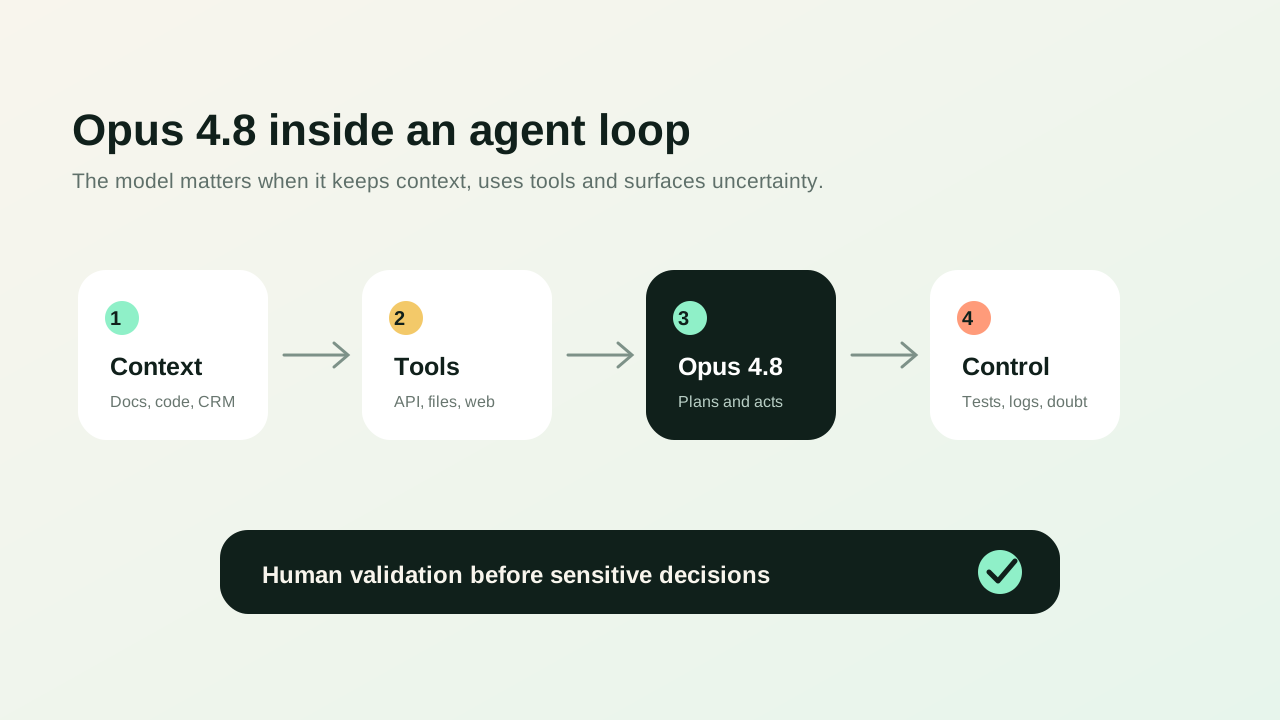
A useful AI agent is not just a model that responds well. It is a system that understands a mission, reads a context, calls tools, produces changes, verifies the effects and knows how to ask for human validation at the right time. The weak link is often consistency: after thirty actions, the model can forget the initial strategy, believe too much in a partial result or mask an area of uncertainty.
This is why the announcements around Opus 4.8 are important for AI and automation projects. The implicit promise is to move AI from a one-off assistant to a collaborator capable of keeping a complete file: exploration, decision, execution, quality control.
Is Opus 4.8 better for code?
Yes, but the most interesting gain is not only writing a function faster. The feedback put forward by Anthropic mainly talks about judgment, better use of tools, correction of errors, the ability to push back when the plan is not sound and more constant monitoring on long tasks.
For a technical team, this changes the eligible use cases: debt audit, framework migration, test redesign, generation of living documentation, integration review, architecture comparison. We would remain cautious about 100% autonomous workflows in production, but Opus 4.8 makes supervised agent mode more credible.
| Usage | What Opus 4.8 improves | Human control recommended |
|---|---|---|
| Refonte de code | Longer exploration, better continuity of reasoning, more structured checks | PR validation, automated tests, security review |
| Analyse documentaire | Context 1M tokens, better synthesis density, more precise citation of sources | Control of critical sources and legal or financial decisions |
| Agent navigateur | More stable use of tools and better end-to-end task performance | Action log, permission limits, validation before writing |
| Business support | More contextualized responses with RAG, memory and cleaner escalation | Human escalation on sensitive cases, audit of hallucinations |
New API features not to be missed
On the developer side, three changes deserve immediate attention. First, the `model` changes to `claude-opus-4-8`. Then, `effort` becomes a central steering parameter: Opus 4.8 uses `high` by default, but you can adjust the effort according to cost, latency and risk level. Finally, system messages during a conversation allow instructions to be updated during a long task without breaking certain cache benefits.
tsconst message = await anthropic.messages.create({
  model: "claude-opus-4-8",
  max_tokens: 8192,
  effort: "high",
  messages: [
    { role: "user", content: "Analyse ce dépôt et propose un plan de migration." },
  ],
})
The detail to watch out for: like Opus 4.7, Opus 4.8 refuses non-default sampling parameters, including temperature, nucleus sampling and top-k. Applications that forced these settings must be cleaned before migration, otherwise they will receive a 400 error.
How to evaluate Opus 4.8 in a company
The wrong way is to ask the model ten awesome questions and choose the one that answers best. For professional use, the complete system must be evaluated: data, prompts, tools, costs, errors, human time saved and level of confidence achieved.
- 1Select 5 real workflows: a code review, a documentary summary, a support agent, a web search, a back-office task.
- 2Build an evaluation game with expected answers, critical errors, ambiguous cases and refusal criteria.
- 3Compare Opus 4.8 to your current model based on documented effort and cost, not just perceived quality.
- 4Measure the human correction rate, time saved, blocking errors and the quality of explanations.
- 5Industrialize only cases where the complete chain is governable: logs, permissions, supervision, rollback.
At Smotly, we would use this phase as an AI architecture audit: what tools can the model call, what data can it see, where to place the human-in-the-loop, how to version the prompts, and how to relate it all to your business goals rather than an isolated demo.
What price for Claude Opus 4.8?
The announced standard price remains at $5 per million input tokens and $25 per million output tokens. Fast mode is announced at $10 per million input tokens and $50 per million output tokens, with a speed up to 2.5 times higher according to Anthropic. It's expensive for generic volume, but consistent for high-value tasks where an error costs more than the calculation.
Gouvernance et risques
The more autonomous the model becomes, the more important governance becomes. A massive context window can ingest a lot of sensitive data. An agent that calls tools can modify a system. An ability to work for a long time can accumulate errors if the controls are not explicit. So the question is not just: “Is Opus 4.8 better?” It becomes: “Do we have the architecture to exploit this gain without losing control?”
- Limit tool permissions by environment: read only, staging, production.
- Log agent actions with inputs, outputs, tool calls and human decisions.
- Separate system prompts, business rules and data retrieved by RAG.
- Define escalation thresholds: doubt, source conflict, irreversible action, sensitive data.
- Test prompts against adverse cases, incomplete documents and conflicting instructions.
SEO, GEO and content impact
For SEO and GEO strategies, Opus 4.8 confirms a trend: mediocre content generated in volume loses interest, while content that is structured, sourced, maintainable and useful to generative engines becomes more valuable. Models are better at summarizing, but they still need reliable sources to cite and signals of authority.
A good use of Opus 4.8 on the content side is not to produce 200 interchangeable articles. It is about transforming real expertise into usable corpus: guides, comparisons, pillar pages, case studies, direct FAQs, structured data and own internal networking.
Our Smotly recommendation
We recommend testing Claude Opus 4.8 in cases where its profile makes sense: long tasks, rich contexts, equipped agents, complex code, document analysis and decisions that require a reliable explanation. For simple, quick or very volumetric tasks, a less expensive model can remain more rational.
Good architecture will rarely be single-model. A robust platform often combines a premium model for judging, planning and controlling, a faster model for executing repetitive tasks, a well-maintained RAG layer, business tools and targeted human validations. Opus 4.8 above all reinforces the value of the premium model in this chain.
Conclusion : vers GPT-5.6 et Mythos
Opus 4.8 gives the impression of a market which is entering a less spectacular but more serious phase: progress is measured in endurance, the ability to use tools, the reduction in silent errors and the governance of agents. This is probably the terrain that the next big models will compete for.
On GPT-5.6, we must remain speculative: if OpenAI continues the trajectory observed with its previous generations, the challenge will not only be to respond more intelligently, but to better orchestrate long actions with memory, verification and controlled cost. The duel with Opus 4.8 will then be decided on practical reliability: how many tasks finished correctly, how many human round trips, how many invisible errors?
As for Mythos, Anthropic already presents it as a superior model class, still limited to defensive cybersecurity uses in Project Glasswing. If this family becomes more widely accessible, it could move the ceiling of reasoning. But it will also impose stronger requirements: strict permissions, security policies, traceability and the ability to say no. The near future of AI will not just be a race for intelligence. This will be a race for actionable confidence.
Written by
Thomas
Smotly
Thomas follows AI uses, agentic architectures and the concrete impacts of new models on Smotly digital projects.
Talk to the team