

Are you wondering if you should adopt this new management approach? You don't know exactly what it can bring you compared to a traditional approach that you already master? Smotly has chosen to provide you with answers through this new article!
Content management systems, also known as CMS, have been around for many years and have evolved a lot. Whether classic, decoupled or even headless, there are different types of CMS on the market. Yes, but what are the differences?
What is a CMS?
CMS stands for “Content management system”. This is a platform that allows you to manage your website, application, etc. It also allows you to create, integrate, modify web content and its formatting.
In short, it is an interface that allows you to manage a website in a simplified way. Traditional CMS often provide a “Drag & Drop” content editing interface that allows you to create and manage your websites without development or coding knowledge.
Classic CMS vs. Decoupled vs. Decoupled CMS Headless CMS
CMS Classique
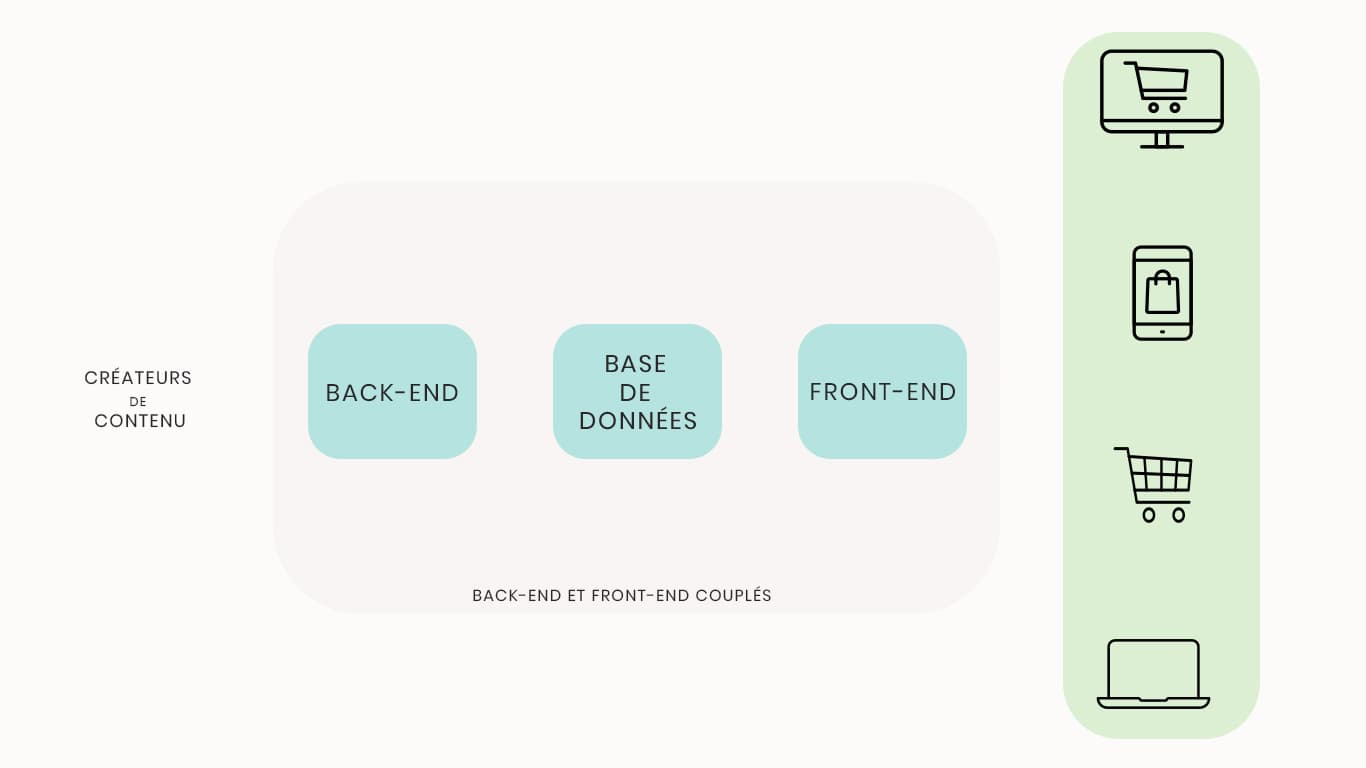
Decoupled CMS
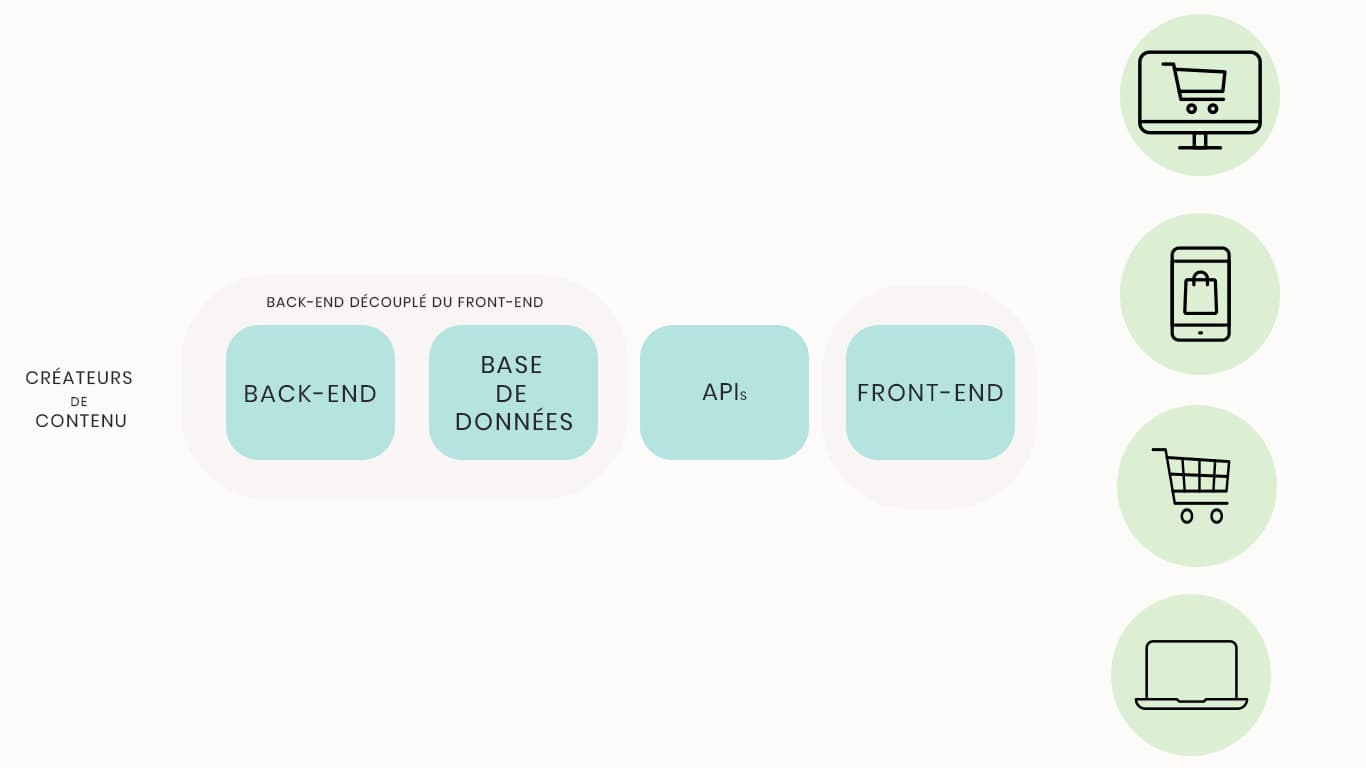
CMS Headless
Indeed, as we mentioned in our article on the advantages of the Bigcommerce solution, BigCommerce offers the possibility of a headless architecture and thus offers a front office completely independent of its back office.
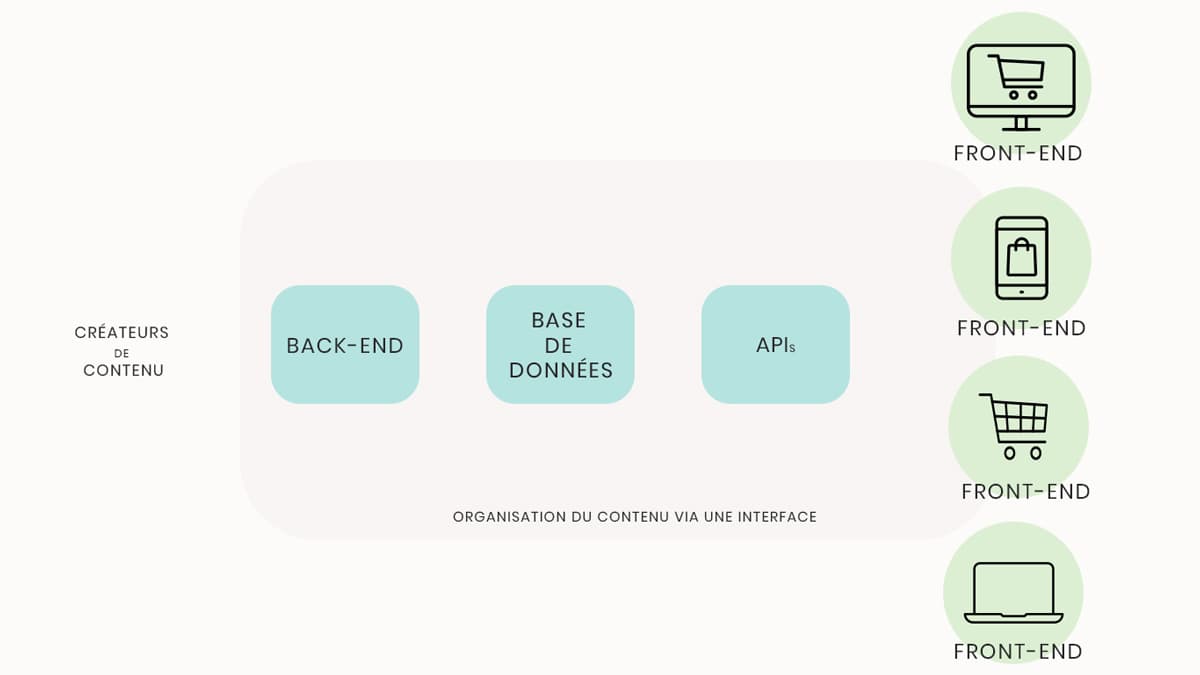
APIs for functionality
The APIs (Application Programming Interface) will play an essential role in the proper functioning of the headless CMS. Indeed, they will collect data from the back office in order to send it back to the different platforms in a standard and consistent format on the different channels responsible for displaying the information. These APIs will therefore play the role of connectors or even intermediaries in order to link the two entirely independent systems.
The advantages of headless e-commerce
A front-end without limits
Choosing headless e-commerce offers limitless creative possibilities. Indeed, the front-end being decoupled from the back-end, developers and web designers face very few constraints and are free to advance each on their own without hindering each other.
Loading performance for SEO
Sites developed under the headless architecture offer record times in terms of page loading. This speed of display facilitates the exploration of robots, improves the user experience and thus offers a better SEO ranking. Indeed, improving the ranking of your website in the results of different search engines will aim to increase your visibility and consequently traffic to your website.
Towards an omnichannel experience
As we mentioned in our previous article, the omnichannel approach is the strategy to adopt. Choosing headless e-commerce allows you to be completely free in publishing your content interactively, whatever the distribution channel: store, computer, telephone, tablet, etc. Headless offers you the possibility to gradually evolve your front-end according to the needs of your business.
Freedom at lower costs
Headless allows you to remain competitive at lower costs. Indeed, this system offers you the possibility of developing your website and different sales channels according to your needs without having to completely overhaul your e-commerce site. This freedom of implementation and choice of customization will therefore allow you to respond quickly to different marketing opportunities and new consumer trends without having to overinvest.
Tailored customer experience
Using a so-called headless platform allows you to improve customer relations. Whether through an e-commerce site, a mobile application, a web portal, the headless architecture will enrich all channels with more precise data but above all, it will allow you to adapt your e-commerce solution to the needs and expectations of your customers. Which by definition means you will be able to deliver customer experiences as customer preferences evolve.
An unprecedented capacity for adaptation
By choosing headless e-commerce, reaction time is considerably reduced. Indeed, your ability to react can make the difference against your competitors. Reducing page loading time also means reducing server reaction time. You will thus be able to act more quickly in the face of changes: put sites online or offline; deploy new processes or ensure the delivery of stocks according to your needs. A headless architecture will help you prepare for daily changes and act quickly no matter what the future may hold.
Ils ont choisi l’architecture Headless
The e-commerce giants have already made the choice of headless. Among the best-known companies, we find Spotify, Netflix, Uber, Amazon, Zalando and Coca-Cola.
Netflix
Netflix is one of the first companies to have chosen headless. Indeed, the VOD giant quickly understood that a classic or even called monolithic architecture was not effective for complex use. Its components being closely linked, the slightest error can lead to a more or less long broadcast interruption and thus the loss of many users.
Amazon
Amazon is the largest e-commerce platform in the world. It started with a small two-level platform, called single. As it developed, it was confronted with system evolution problems. Many factors have delayed the growth of the giant: extended deployment times, large databases, difficulties in adding new features, etc.
Coca-Cola
The multinational company Coca-Cola has more than three thousand products in its global catalog and subsidiaries in each country. She is thus confronted with the difficulty of connecting the different entities together. The group has therefore chosen headless and its APIs to help it maintain its international growth.
Zalando
From a simple flip-flop store to a world-famous brand, Zalando has found a solution capable of adapting to millions of users. But also to support multiple platforms and manage complex business rules. The move to headless and micro services gave it the possibility of facilitating the integration of new concepts and thus being less sensitive to breakdowns.
The Headless in summary…
Headless e-commerce, this new concept of software development, is poised to become one of the trends that will revolutionize e-commerce. The idea is to separate the user interface (front-end) from all the functionality of the website (back-end). This concept therefore offers all companies the same manageability and, above all, flexibility, whether they are an established company or a start-up. We can reasonably think that, within 3 to 4 years, all companies will have headless e-commerce solutions.
This is also one of the reasons that led us to offer the BigCommerce solution since 2021. It indeed offers the possibility of setting up a headless architecture with its back-end in Open SaaS mode. The BigCommerce platform therefore offers numerous services and features: Google Cloud, regular updates, personalized assistance, features allowing you to manage a BtoB model or even international deployment through currency support and also the multi-store option.
For the front-end, we offer our solution in SaaS mode, also based on the Google Cloud infrastructure and which can go as far as the development of a PWA (Progressive Web App).