
The choice of a structuring e-commerce platform is a strategic issue for any company aiming for rapid or international growth. Between Sylius, an ultra-flexible open source framework and Shopify Plus, a premium turnkey SaaS solution, which tool will best meet your needs?
Discover our comparison to make the choice best suited to your strategy and business challenges.
1. Sylius vs Shopify Plus: overview and positioning of e-commerce solutions for ambitious projects
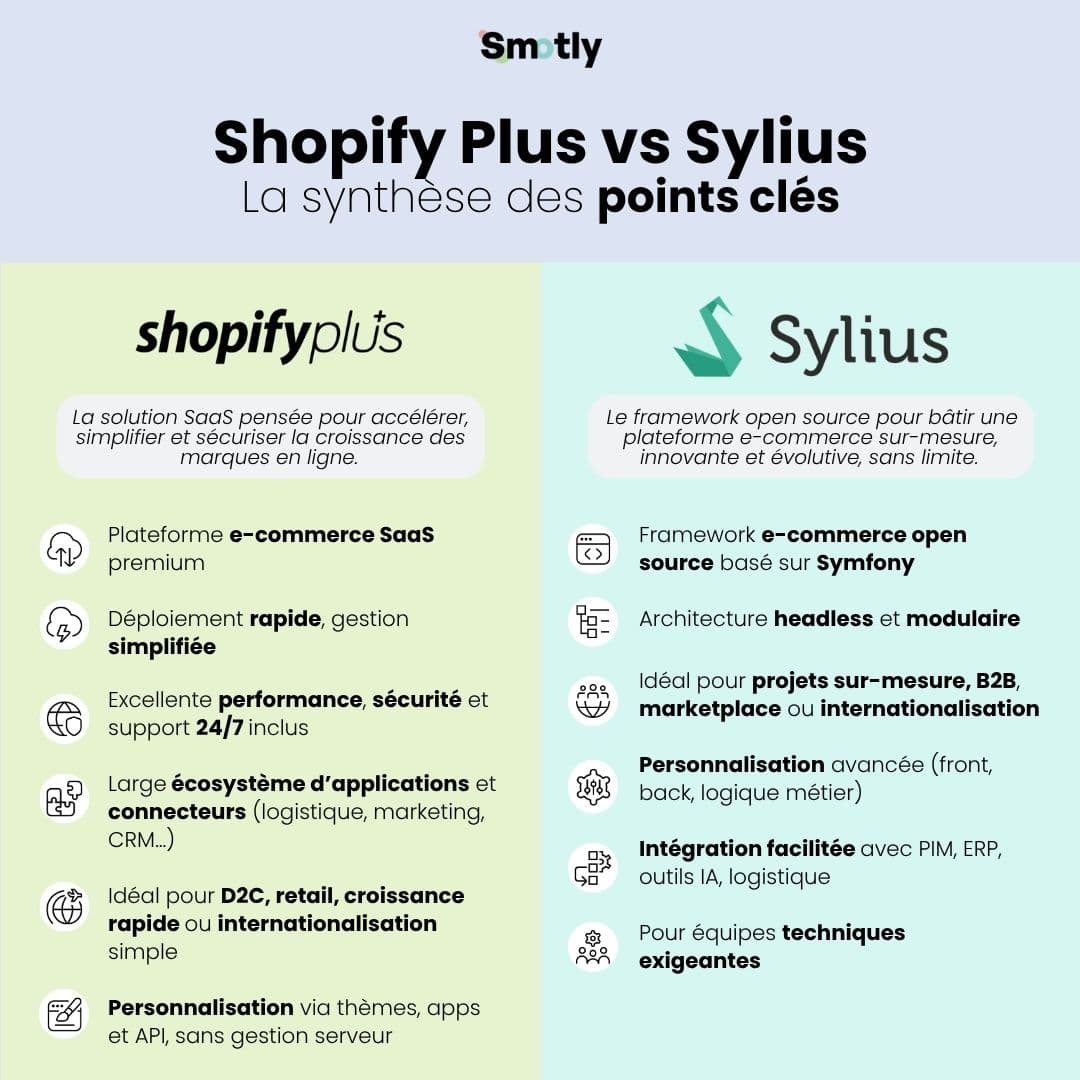
| Criterion | Shopify Plus | Sylius |
|---|---|---|
| Model | Premium SaaS platform | Framework open source |
| Architecture | Headless, API-first, modulaire | Monolithic, API-first, hosted |
| Personnalisation | By themes & apps, limited to the ecosystem | Advanced (front, back, business logic) |
| Projets cibles | B2B, B2C, D2C, retail, croissance rapide | Customized, B2B, marketplace, international |
| Prise en main technique | Accessible, no server skills required | Advanced level, dev team recommended |
| Scalability | Native scalability, within SaaS limits | Maximale, selon ressources internes |
| Support | Dedicated support, official resources | Community, specialized partners |
2. The criteria to take into account when choosing your e-commerce solution
Choosing a high-performance e-commerce platform is a strategic step for any e-commerce site creation or redesign project. It is essential to align the technical solution with your business objectives, your operational constraints and your growth ambitions.
Before opting for an e-commerce framework like Sylius or a SaaS platform such as Shopify Plus, it is important to review the determining criteria that will structure the success and scalability of your e-commerce project: personalization, time-to-market, budget, internationalization, logistics integration, security, automation, support... So many levers that will make the difference in a competitive market.
Criterion #1
Customization of the e-commerce solution
How far do you want to adapt your online store, your workflows, your product catalog? Are your customers B2B? B2C? Both ? Should customer segments be addressed differently and have their own customer journey?
Criterion #2
Speed of launch and time-to-market
Is your priority to quickly launch your e-commerce site or to build a robust technical foundation?
Criterion #3
Cost of the e-commerce project and ROI
What is the budget allocated to the creation, maintenance and evolution of your platform? Please note that the budget must be considered in its entirety and also take into account hidden costs: license, subscriptions, maintenance, etc.
Criterion #4
Platform scalability and scalability
Does your project need to be able to handle growth, traffic peaks, an expanded catalog?
Criterion No. 5
Internationalisation, multi-boutique et multilingue
Are you targeting multiple markets, languages or currencies? Do these areas have specificities specific to their market and location?
Criterion No. 6
Integrations & application ecosystem
Should you connect PIM, ERP, CRM, logistics or AI solutions to your site?
Criterion No. 7
User and mobile experience
What are the consumption habits of your customers? Is your traffic mainly mobile or desktop? Is web design a central point for you or do you focus more on functionality?
Criterion No. 8
Security, GDPR compliance and maintenance
What guarantees do you require on the data security and regulatory compliance of your online store?
Criterion n°9
Automatisation, intelligence artificielle et innovation
Do you want to automate tasks, use AI for product recommendations or personalization?
Criterion No. 10
Support, technical support and community
Are you looking for long-term maintenance, support for your teams and management autonomy? Would you also like to be guided on SEO, SEA or Artificial Intelligence audit services?
In summary, precisely identifying your needs and priorities will allow you to select the e-commerce solution best suited to your context and your ambitions. Each criterion has a direct impact on the sustainability and performance of your future e-commerce site. This upstream reflection, structured around business issues and field reality, constitutes the first step to guarantee the success of your e-commerce project, today and tomorrow.
3. Sylius: for what types of ambitious e-commerce projects?
Why choose Sylius for a tailor-made e-commerce project?
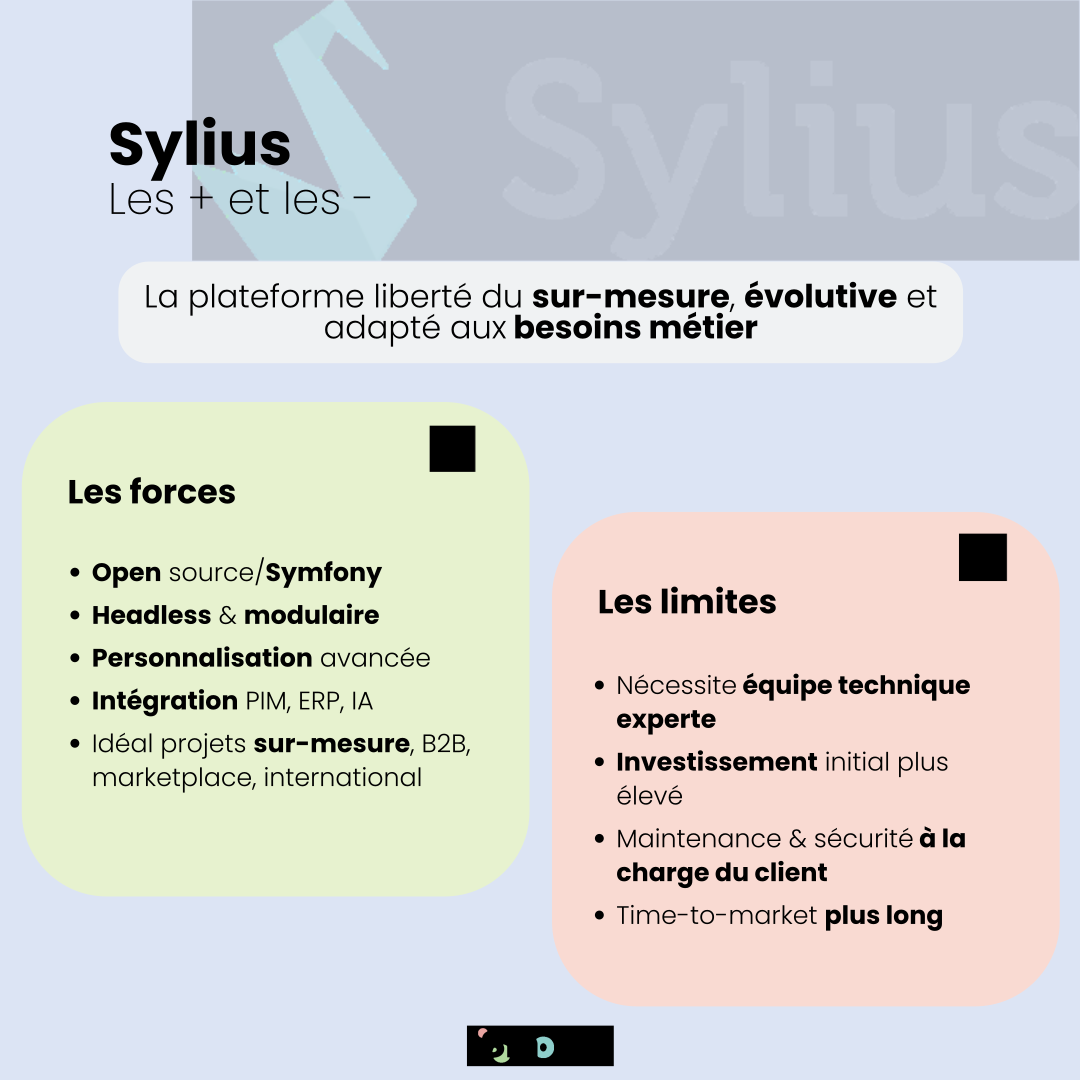
Sylius is primarily aimed at companies and organizations that wish to go beyond the limits of traditional e-commerce solutions. Its “framework” philosophy makes it possible to design fully personalized platforms in line with specific business requirements: complex flow management, multi-seller marketplaces, advanced B2B logic, or even multi-store and multi-language orchestrations.
Examples of e-commerce projects adapted to Sylius (B2B, marketplace, internationalization)
1️⃣ B2B or marketplace projects: management of complex catalogs, multi-pricing, validation workflow, advanced integration with business tools.
2️⃣ Advanced internationalization: fine management of languages, currencies, taxes and local contexts, ideal for multi-brand groups or companies targeting several markets simultaneously.
3️⃣ Differentiating user experiences: thanks to the headless architecture, Sylius makes it possible to connect tailor-made front-ends, mobile applications or PWA solutions, to offer a personalized omnichannel experience.
4️⃣ Automation & AI: its flexibility facilitates the integration of recommendation engines, semantic search, personalization tools, predictive analysis or marketing automation modules.
Technical and SEO advantages of Sylius for high-performance e-commerce sites
Sylius has established itself as a benchmark for organizations seeking to build an e-commerce platform that is powerful, flexible and scalable. Its modular and API-first architecture allows seamless integration with key e-commerce business tools: PIM, ERP, CRM, logistics solutions or marketplace. This technological openness guarantees the consistency and agility of the entire information system, while allowing each link in the value chain to be personalized.
On the natural referencing side, Sylius offers a decisive advantage: complete control of the code makes it possible to optimize the structure of URLs, the management of multilingual content, or even the implementation of structured data, in perfect harmony with the requirements of search engines. This ability to build a tailor-made SEO strategy represents a real growth lever for companies targeting competitive or international markets.
When it comes to security and compliance, Sylius does not compromise. The fine management of rights, the adaptability to GDPR constraints and the possibility of implementing specific business rules meet the expectations of the most demanding companies, particularly those operating in highly regulated sectors.
Points to watch out for before opting for Sylius as an e-commerce solution
Choosing Sylius means betting on personalization and technological mastery. This orientation, however, requires having an experienced development team, capable of ensuring the design, development and maintenance of the platform. The initial investment is generally more substantial than for a SaaS solution but it is part of a logic of long-term profitability, thanks to the independence and sustainability of the architecture.
It is also important to integrate the ongoing management of security, updates and performance into the project organization: where a managed solution takes care of these aspects, Sylius leaves the company – or its partner – with the responsibility of ensuring an impeccable level of service. Rigorous anticipation of these issues is therefore essential to guarantee the success and stability of the project over time.**
4. Shopify Plus: for what types of ambitious e-commerce projects?
Why choose Shopify Plus for your e-commerce site?
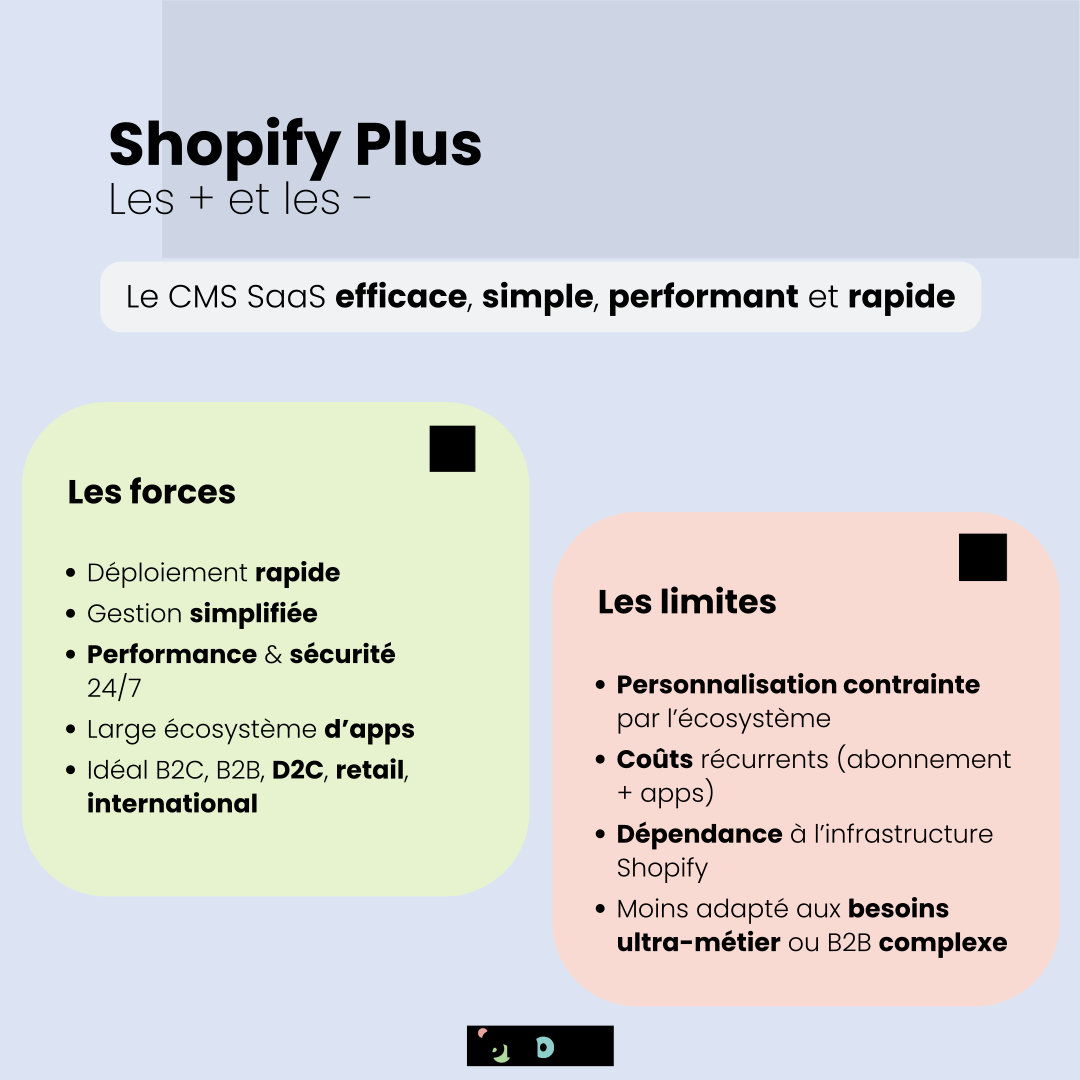
Shopify Plus has established itself as the benchmark SaaS solution for companies and brands wishing to accelerate their online development without complicating their internal organization. Its main advantage lies in the simplicity of deployment: everything is designed to allow rapid uploading, frictionless management and immediate handling, even for non-technical teams. Infrastructure, hosting, security and maintenance are entirely managed by Shopify ensuring optimal uptime and peace of mind, even during peak activity.
Examples of e-commerce projects adapted to Shopify Plus (D2C, retail, rapid growth)
1️⃣ Launch or scaling of D2C brands: Shopify Plus is particularly popular with brands who want to launch quickly, test new markets or industrialize their direct sales processes without depending on an internal development team or incurring large costs.
2️⃣ Retail and multichannel: the platform facilitates the simultaneous management of online stores, physical points of sale and marketplaces thanks to a unified back office and numerous ready-to-use connectors.
3️⃣ Simplified internationalization: Shopify Plus offers native tools for multi-language, multi-currency management and localization of customer experiences, suitable for companies that want to deploy internationally without any hassle.
4️⃣ Automation & accessible AI: the Shopify app ecosystem makes it easy to integrate marketing automation, product recommendations, automatic translation or intelligent inventory management modules without specific development.
Shopify Plus: what are the benefits for a growing business?
The strength of Shopify Plus lies in its turnkey approach: performance, security, hosting and support are natively integrated, allowing teams to focus on growth, marketing and customer experience. The very extensive application ecosystem offers great functional richness: logistics connectors, CRM solutions, personalization tools, AI and automation modules, everything is accessible via a robust application marketplace. The platform, designed API-first,** integrates easily with the main business tools, while offering the possibility of extending functionalities via personalized applications or private APIs.
Shopify Plus also stands out for the quality of its support and support: each customer benefits from a dedicated account manager and rich documentation.
The constraints of a Shopify Plus site as an e-commerce solution
If Shopify Plus seduces with its simplicity and speed of deployment, it imposes certain limits. Personalization, although pushed via themes and the vast catalog of applications, remains constrained by the ecosystem of the platform and may encounter its limits for projects requiring tailor-made developments or very specific business logic. The monthly subscription, to which are added the costs of third-party applications** and commissions on sales, must be anticipated in the economic model, especially on a large scale.
Finally, data management, GDPR compliance or certain advanced SEO optimizations can be more complex to implement than with an open source solution, particularly for companies with strong requirements in terms of data ownership or fine management of multilingual content.
5. Advanced e-commerce features: Sylius vs Shopify Plus
To have a successful e-commerce site, the functional richness of the platform is a decisive criterion. PIM integration, logistics management, automation, personalization, omnichannel: each solution brings its strengths and limitations.
Which e-commerce platform best meets your business needs? Sylius vs Shopify Plus
| Functionality | Sylius | Shopify Plus |
|---|---|---|
| Gestion du catalogue | Highly advanced, customizable, B2B/B2C | Complete, simple, limited by model |
| PIM integration | Native ou via connecteurs (Akeneo, etc.) | Via apps tierces, connecteurs disponibles |
| Connecteurs logistiques | Custom integration, API, WMS, ERP | Large choix d’apps, connecteurs natifs |
| Inventory management | Multi-warehouse, custom rules | Multi-warehouse, native management |
| Paiement | Connecteurs custom, tous PSP possibles | Native and app integrations, Shopify Payments |
| Customer journey personalization | Unlimited, via development | Via themes, apps, limited outside ecosystem |
| Promotions & pricing rules | Ultra-flexible, advanced business logic | Standard management, apps for complexity |
| Multi-boutique / multi-langue | Yes, advanced management, tailor-made | Yes, via Shopify Markets, apps, limited |
| Gestion B2B | Forte, workflows personnalisables | B2B functionalities via apps, limited |
| Marketplace | Possible, specific development | Possible with apps, limited |
| API / Headless | Architecture native, API-first | API-first, headless possible |
| Security & Compliance | Tailor-made, adaptable GDPR | Natively managed by Shopify |
| Reporting & Analytics | BI integrations, tailor-made | Rapports natifs, apps analytiques |
| Automatisation & IA | Sur-mesure, intégrable via API | Wide choice of AI apps, turnkey automation |
🌟 Focus: Artificial intelligence, automation and advanced personalization
The integration of artificial intelligence is today a differentiating factor for any e-commerce site wishing to offer a personalized experience, automate high value-added tasks and optimize commercial performance.
![GitHub - Sylius/SyliusProductBundle: [READ-ONLY] Product catalog bundle for Symfony](/_next/image/?url=%2Fblog%2Fsylius-vs-shopify-plus-comparatif-solution-ecommerce%2Fsylius-logo-800.png&w=1536&q=75&dpl=dpl_AEzsnLBuWLU7UVsRon8eiyv3bR5m)
Thanks to its open architecture and API-first logic, Sylius makes it possible to integrate new generation AI solutions** such as Dust and other specialized platforms. This opens the door to a wide range of uses: intelligent product recommendations, advanced semantic search, conversational chatbots, predictive analysis of customer behavior, automation of marketing campaigns, etc.
Sylius stands out due to the fact that these functionalities can be developed tailor-made, in full compliance with the business model, the structure of the catalog and the internal processes of the company. This approach guarantees complete control of data and the possibility of building truly differentiating experiences, while keeping control of innovation.
It is a relevant choice for companies that wish to anticipate market developments and stay at the forefront of personalization and automation in e-commerce.
For its part, Shopify Plus is banking on accessibility to innovation via a vast catalog of AI applications available on its marketplace. Personalized recommendations, automatic segmentation, instant translation, intelligent inventory management, chatbots or customer service automation: the majority of these uses are accessible without specific development, thanks to plug & play logic. For more advanced needs, it is possible to integrate third-party technologies like Dust via API or personalized apps, even if customization remains, by nature, more regulated than with an open source architecture. This approach allows marketing and e-commerce teams to quickly deploy powerful tools, while maintaining the simplicity and robustness of the Shopify ecosystem.
6. How to choose: Sylius or Shopify Plus for your e-commerce project?
The choice between Sylius and Shopify Plus depends above all on your vision, your functional needs, your organization and your growth ambitions.
To make the right choice of e-commerce platform, it is essential to ask yourself the right questions:
Is your priority total customization, tailor-made integration and technological mastery?
→ Sylius is ideal for projects requiring extreme flexibility, headless architecture, marketplace management, complex B2B or a totally differentiating customer experience. It is the choice for companies who want to keep control of their roadmap, manage advanced AI integrations (Dust type or others) and orchestrate their digital ecosystem down to the smallest detail.
Are you looking for accelerated time-to-market, simplified management and premium support?
→ Shopify Plus is ideal for brands who want to focus on their growth without the hassle of technical constraints. The platform allows you to quickly launch a successful online store, easily scale internationally (multi-languages, multi-currencies), and exploit innovation via its app store. It is the recommended solution for D2C, retail or high-dynamic e-commerce projects.

Is your project part of an international or omnichannel approach?
Both platforms allow you to manage multi-country stores and personalized customer journeys, but Sylius offers greater configuration granularity for very complex contexts, while Shopify Plus favors speed and simplicity to establish yourself in new markets.
Are AI innovation and automation at the heart of your strategy?
Sylius allows you to integrate advanced, tailor-made AI solutions for deep personalization based on data. Shopify Plus propose un accès immédiat à des outils d’IA, d’automatisation marketing et de personnalisation via son écosystème applicatif, avec une mise en œuvre plug & play.
7. Our Smotly recommendations
Start-up or hyper-growth brand, small technical team, need to move quickly?
Choose Shopify Plus for its ability to get your e-commerce business off the ground quickly and frictionlessly.
ETI, groupe multi-marques, marketplace, enjeux B2B ou catalogue complexe ?
Opt for Sylius to build a robust, scalable digital base, perfectly aligned with your business specificities and your innovation strategy.
Hybrid project, need to arbitrate?
Get support from an expert e-commerce agency to audit your needs, map your processes and simulate the total cost of ownership (TCO) over 3 to 5 years, integrating the international dimension, automation, SEO and scalability.
There is no universal solution, but a choice to make based on your vision, your digital maturity and your growth objectives. Taking the time to analyze your priorities, challenge your assumptions and validate technical feasibility with a trusted partner remains the best guarantee of success in an increasingly competitive e-commerce market.
Conclusion: Sylius or Shopify Plus: the summary for choosing the best e-commerce platform
The success of an ambitious e-commerce project relies first on the choice of a solution adapted to your challenges: Sylius for maximum customization and technical mastery, Shopify Plus for rapid growth and simplified management.
Each has distinct advantages, in terms of flexibility, time-to-market, integrations and innovation. The main thing is to align your platform with your vision, your resources and your development strategy.
At Smotly, we support our clients to transform their digital ambition into concrete success, by carefully analyzing their needs, anticipating market developments and designing e-commerce platforms adapted to each project, whether on Sylius, Shopify Plus or a hybrid architecture. So don’t hesitate to contact us!